Table of Contents
- Core Timeline Components
- Seasonal Considerations and Venue Logistics
- Allocating Time for Portraits and Candids
- Integrating Technology and Social Media
- Scheduling Reception Lighting and Decor Photography
- Managing Reception Events: Scope and Limitations
Core Timeline Components
A wedding photography timeline is not a list of appointments. It is a light map, a movement plan, and a behavioral forecast braided into one document.
I start with sunset, then work backward. That single decision keeps the day honest. In the Tri-State area, sunset can shift by roughly 2 to 3 minutes per day during the autumn equinox, which means a timeline borrowed from a wedding one week earlier can already be wrong enough to wound the portrait hour.
The Anchor Points
The critical phases are simple to name and harder to protect: preparation, first look, family portraits, couple portraits, ceremony coverage, cocktail hour, empty-room decor, reception entrances, toasts, dinner, and dance coverage. Each phase asks for a different kind of attention from the photography studio. Preparation rewards patience. Portraits reward control. Reception coverage rewards anticipation.
The practical question is not, “How long does photography take?” The better question is, “Which minutes cannot be recovered if they are lost?”
- Natural light portraits should sit closest to the best available exterior light, not wherever the planner’s first draft happens to place them.
- Family portraits need a contained location, a printed grouping order, and a designated caller who knows the family dynamics.
- Reception documentation needs access before guests enter, especially when lighting design carries the emotional architecture of the room.

Main Point: The strongest timelines do not treat photography as decoration. They reserve protected blocks for the moments that require precision: portraits, lighting setups, transitions, and reception events.
Seasonal Considerations and Venue Logistics
October in Philadelphia is seductive and unforgiving. The trees begin to turn, river light softens, and everyone suddenly remembers why they wanted outdoor portraits in the first place.
Then traffic enters the frame.
Foliage Is a Scheduling Variable
Foliage timing matters because color, density, and canopy shade alter the portrait plan. A couple imagining amber trees along the Schuylkill should not receive a noon schedule that flattens the leaves into glare. A shaded garden can look painterly at one hour and dull at another. The date, the tree cover, and the sun angle belong in the same conversation.
Federal reporting identifies August as the peak month for US wedding license applications, and that seasonal pressure reaches vendors, venues, permits, and hotel load-in zones. I do not treat that as trivia. It affects how much friction a wedding day can absorb.
The Downtown-to-River Test
For Philadelphia venue planning, the route matters more than the map. A timeline that moves from the Four Seasons Philadelphia to Waterworks needs more than a mileage estimate; it needs a field check. The planning team should physically drive the route during the same day of week and hour as the wedding, because Saturday afternoon congestion behaves differently than a Tuesday morning test.
A typical transition from a central city hotel to a riverside venue requires a buffer in the vicinity of 40 minutes on a Saturday afternoon in October. Failing to account for that Saturday traffic buffer between downtown and park venues often results in entirely missing the golden hour portrait window.
Caution: Do not hide travel inside portrait time. If the couple wants riverside photographs, the timeline must pay for the drive openly.
The most elegant timeline is often the least romantic on paper. It names traffic, walking distances, elevator delays, valet congestion, and shoe changes. That candor protects the romance later.
Allocating Time for Portraits and Candids
The best “candids” during couple portraits are usually structured enough to feel safe and loose enough to breathe. That is not deception. It is choreography.
The Uninterrupted Bridal Portrait Block
Dedicate on the order of 18 to 22 minutes exclusively for bridal portraits. Not “somewhere after family photos.” Not while florals are being pinned. Not while three relatives ask for phone pictures. The subject needs time to settle into the lens.
During that block, Faith West, as lead photographer, can build a line of sight: a visual path that lets the bride understand where her gaze, shoulders, hands, and dress line should travel. Once that path exists, the photographs begin to feel less posed even when the direction remains precise.
- The almost-kiss works best as a pause within motion, not as a frozen command.
- The coquettish curled hand needs a soft wrist and a reason to exist, such as adjusting a veil edge or grazing the bouquet ribbon.
- Walking toward the lens gives the couple a task, which reduces facial tension and keeps the frame alive.
For one Ballroom at the Ben wedding, I would rather protect one deep portrait sequence in a grand interior corridor than scatter five shallow portrait attempts across every staircase and window. The architecture there already carries weight. The couple does not need to compete with it; they need to move through it with intention.
Directed Candor Without Stiffness
The continuous motion loop is the field method I trust most: walk, lean, pause, almost touch, separate, laugh, reset. The photographer watches the microsecond when performance drops and tenderness returns.
That is the frame worth waiting for.
Expert Tip: Give the couple verbs, not poses: walk, fold, turn, reach, breathe. Verbs create photographs that feel lived in.
Integrating Technology and Social Media
Technology earns its place only when it supports the wedding rather than interrupting it. Wireless transmission, live-feed coverage, and event hashtags can all help, but each one consumes time before it becomes invisible.
Wireless Transmission Needs Its Own Window
Hardware setup and network handshakes for CamRanger devices require a dedicated circa 12- to 15-minute window prior to the first look. This cannot share space with veil placement or parent reveals. The digital tech team needs a localized wireless network, correct camera pairing, and a test push of low-resolution JPEGs before the emotional sequence begins.
In practice, the required buffer for wireless image transmission setup varies significantly depending on the venue's architectural interference, with historic stone buildings demanding longer network handshake times than modern open-concept spaces. In Philadelphia, that detail matters. Thick walls, service corridors, and basement getting-ready suites can turn a clean workflow into a stalled one.
Live Social Coverage
When a social media manager such as Gabrielle Tierney joins the vendor team, the photography timeline should identify who receives images, when they receive them, and what can be posted before the ceremony. The question is not merely technical. It is editorial.
An event-specific hashtag such as #TheBergenWall belongs in the digital workflow before the wedding morning. The team should confirm spelling, capitalization preference, couple approval, and any embargoed details. A hashtag printed on signage but absent from the capture plan becomes decorative noise.
- Confirm the wireless device setup location.
- Test image transfer before the first emotional event.
- Define which images may move to the live-feed queue.
- Keep full-resolution editorial culling separate from rapid social delivery.
Speed has value. So does restraint. A wedding day is not a press conference; it is a private ritual with selective public windows.
Scheduling Reception Lighting and Decor Photography
Reception decor photography is where many timelines become vague at the exact moment they need to become surgical.
The Empty-Room Block
The empty-room photography block requires a 15- to 20-minute window, thereabouts, of completely cleared floor space, scheduled immediately after the lighting technicians finalize the custom go-bo stencil projections. That window is not generous. It is barely enough when the room includes layered linen textures, glassware, candles, ceiling treatments, and lighting cues.
The lead photographer should coordinate with providers such as Evantine Design, Eventions, or Synergetic Sound and Lighting to trigger the full room reveal state. I prefer to photograph the broad wash lighting on the dance floor first, then move toward focused pin spotting on tables, then finish with floor-to-ceiling uplighting and custom projection details. Wide, medium, detail. That order keeps the visual record coherent.
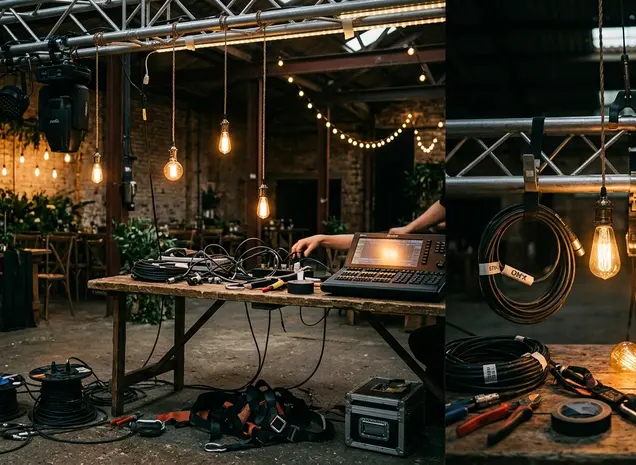
One catch: capturing pristine floor-to-ceiling uplighting requires the catering staff to halt all table setting adjustments during this specific window, which can disrupt tight venue turnaround schedules. This is not a small ask. Catering teams work under pressure, and the photography request should be made early enough that no one hears it as a last-minute obstruction.
Caution: If guests enter before the room is photographed, coats, handbags, half-filled water glasses, and moved chairs become part of the permanent visual archive.
Why Decor Coverage Deserves Protection
Couples often invest months of taste into a reception room they will see for only a few breathless minutes before introductions begin. The photographs become their evidence of that labor. The table pin spots, the dance floor wash, and the go-bo stencil are not background; they are part of the evening’s atmosphere.
Ignore them, and the story loses its setting.
Managing Reception Events: Scope and Limitations
A ceremony timeline can be measured with discipline. A reception timeline must be negotiated with appetite, emotion, alcohol, music, and the human tendency to stand up slowly when dinner is served.
Toasts and Schedule Integrity
According to common estimates, toasts are best capped at 3 to 4 minutes per speaker to prevent a cascading delay in dinner service and subsequent dance floor coverage. That recommendation is not about suppressing feeling. It is about preserving the arc of the evening.
A concise toast lands harder than a wandering one. The speaker knows where the story begins, where it turns, and where it should end. The room stays attentive. The catering team keeps its timing. The photography studio can cover reactions without sacrificing later events.
- Confirm the number of speakers before finalizing the reception timeline.
- Place speakers near the couple, not across the room behind obstructed sight lines.
- Ask the entertainment team to hold music cues until the photographer has position.
- Keep champagne pours and microphone handoffs out of the speech time estimate.
Working With the Band, Not Around It
When entertainment such as Sid Miller Dance Band leads the evening, the photography team should review the musical flow beforehand. The shift from dinner ambiance to open dancing changes lens choice, flash placement, and photographer position. A bandleader’s cue can matter as much as a planner’s cue.
This is also where timeline control reaches its limit. A dance floor may ignite early. A parent may pull the couple into an unscheduled embrace. A crowd may form around the bandstand and block the planned angle. The photographer can prepare for these conditions, but cannot sterilize them, and with Philadelphia traffic and venue access never behaving like predictable conditions, the best plan remains disciplined rather than brittle.
Main Point: Reception coverage succeeds when the timeline protects what can be controlled and leaves enough air for what cannot.
That balance is the real strategy. Not more minutes everywhere. Better minutes where they matter.