Executive Summary: Curating the Unconventional
Every love story is entirely its own, and your wedding photography should reflect that singular narrative. At Faith West Photography, the curation process began by mapping out the city's historic grid and overlaying it with pedestrian traffic patterns to isolate zones that offer high architectural romance but low footfall. Moving away from highly trafficked landmarks toward secluded, architecturally rich environments provides the spatial privacy necessary for authentic documentation.
Balancing aesthetic value with logistical feasibility remains the core challenge of urban engagement sessions. Whether you are planning a grand celebration at the Ballroom at the Ben or an intimate gathering, the engagement session sets the visual tone. This article explores three primary location typologies: historic alleys, botanical reserves, and industrial textures.
Methodological Approach to Location Selection
Defining a hidden gem in a densely populated urban center requires close environmental observation. Ambient light behaves vastly differently in narrow city corridors compared to open park spaces. I evaluated this light behavior by tracking shadow progression across various topographies. I prioritize locations where the surrounding structures act as natural diffusers.
This spatial privacy is not merely a logistical preference—it is a fundamental requirement for eliciting authentic, documentary-style couple portraits without the distraction of an audience. When couples feel isolated from the bustling city, their interactions become noticeably more relaxed and genuine.
Case Studies: Architectural Enclaves and Historic Alleys
Selecting Society Hill's lesser-known thoroughfares involved walking the grid at different times of day to observe how the 18th-century cobblestone interacts with directional light. Quince Street and Delancey Place offer profound textural benefits through their weathered brick facades. However, timing is critical in these environments.
Directional light windows in narrow Society Hill alleys can last in the vicinity of 20 to 35 minutes before the sun dips below rooflines of about three stories. Attempting a golden hour shoot in a narrow alleyway without accounting for building height results in flat, underexposed portraits. Precision in scheduling dictates the success of these architectural sessions.
Expert Tip: The textural impact of cobblestone streets changes drastically when wet, requiring different lighting angles to manage reflections compared to dry conditions.
Case Studies: Secluded Botanical and Natural Reserves
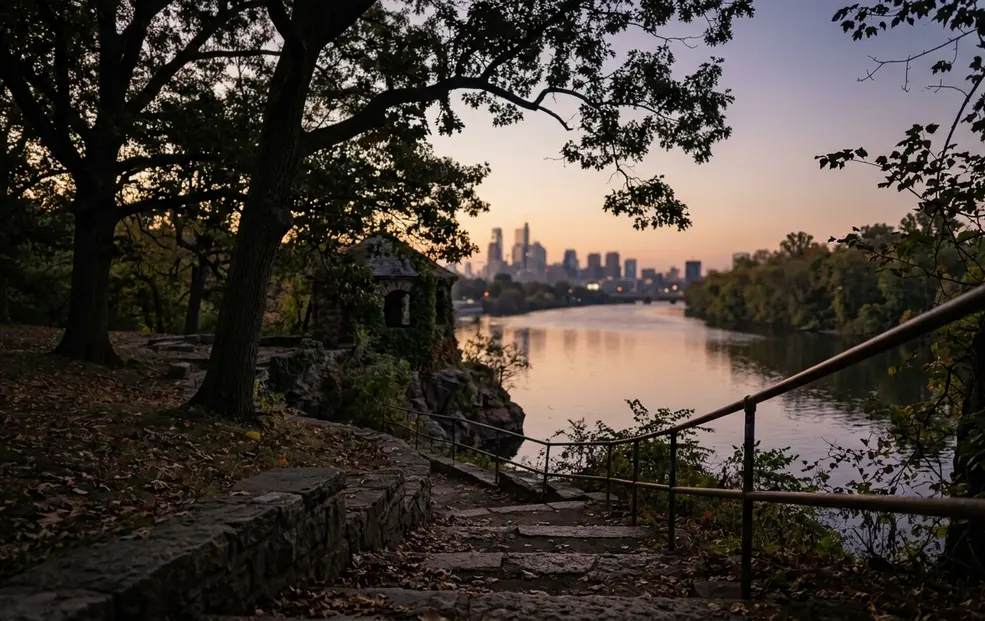
Mainstream horticultural centers often lack the intimacy required for deeply romantic sessions. To find viable alternatives, I cross-referenced historical estate registries with current public access schedules. This search focused on properties that maintain a slightly overgrown, organic landscape, such as Awbury Arboretum or Bartram's Garden.
Integrating these wilder environments with formal, elegant wardrobe choices creates a compelling visual tension. A tailored suit or a flowing gown stands out beautifully against untamed foliage. Seasonal variations dictate the photographic color palette, shifting from vibrant spring greens to muted, sophisticated autumn ochres.
Case Studies: Industrial and Alternative Textures
The inclusion of the Callowhill district was driven by a desire to juxtapose luxury wedding attire against brutalist architecture. This approach required physical scouting to identify safe, accessible areas with striking visual contrast. The Navy Yard's peripheral zones offer similar documentary realism.
Compositional strategies in these industrial sectors rely heavily on wide-angle environmental portraits. By framing couples against massive, weathered steel structures, the sheer scale of the surroundings amplifies the intimacy of the subjects—a hallmark of the Faith West approach to visual storytelling.
Scope and Logistical Limitations
Assessing logistical limitations required compiling municipal permit regulations and cross-referencing them with the physical accessibility of each site to ensure couples in formal wear could navigate the terrain safely. Permit processing for certain municipal historical sites often requires a lead time of 14 to 21 business days. You can review the Philadelphia Parks & Recreation permit guidelines for specific municipal requirements.
Caution: Utilizing peripheral industrial zones requires securing a certificate of insurance (COI) naming the property management entity as an additional insured, which excludes spontaneous, unpermitted sessions.
While these curated locations consistently yield striking architectural portraits, environmental unpredictability means no single lighting strategy is universally guaranteed across all urban topographies. Mitigating risks associated with unpredictable urban environments and weather conditions requires a flexible approach and a deep understanding of the city's microclimates.
Implementation Strategy for Couples
Developing the timeline strategy involved mapping the 'blue hour' in obstructed urban canyons. I determined that sessions must begin earlier than traditional open-sky shoots to capture the desired romantic atmosphere. Specifically, urban canyon sessions are scheduled to commence on the order of 45 to 65 minutes prior to the standard published sunset time to compensate for structural light obstruction.
Collaborative communication with your service provider ensures the chosen location aligns perfectly with your narrative. Wardrobe coordination should directly complement the specific architectural or natural textures of the selected site.
Urban Engagement Session Preparation
- Verify municipal permit processing times for historic sites.
- Secure Certificate of Insurance (COI) for industrial or private estate locations.
- Adjust start times by circa 45-65 minutes for urban canyon light obstruction.
Main Point: Proper preparation and precise timing transform challenging urban environments into breathtaking, highly personalized photographic canvases.