Table of Contents
- Executive Summary and Key Takeaways
- The Challenge: Navigating Scale and Mixed Lighting
- Technical Implementation: A Strategic Lighting Network
- Compositional Approach: Balancing Grandeur and Intimacy
- Project Outcomes and Scope Limitations
Executive Summary and Key Takeaways
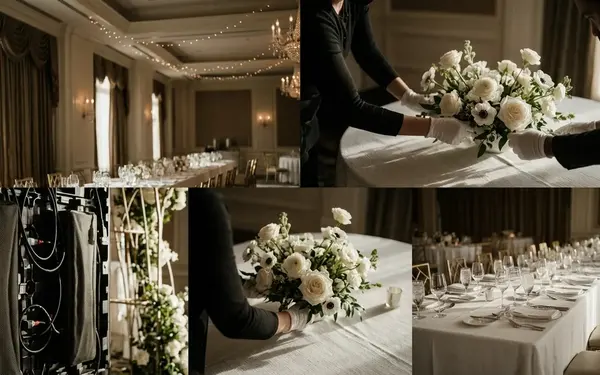
The Ballroom at the Ben presents a magnificent architectural scale, steeped in Philadelphia's historical significance. Capturing its grandeur requires a photography studio to navigate expansive ceilings, mixed ambient lighting, and a multi-level event flow. Every love story is entirely its own, and documenting it within such a monumental space demands rigorous technical precision paired with an artistic sensibility. Through an ongoing venue documentation initiative established circa 2018, the team mapped the venue's architectural footprint during the final walkthrough, deciding to treat the multi-level space as two distinct lighting zones rather than attempting a single, overpowering lighting solution.
Faith West’s approach centers on the methods used to preserve the romantic atmosphere of the venue while ensuring crisp, timeless portraits. Technical solutions include off-camera strobe networks and careful lens selection. By dividing the room into specific coverage areas, the photography team ensures that neither the intimate moments nor the grand environmental context is lost to the shadows. The approach prioritizes the authentic mood of the celebration over sterile, uniform illumination.
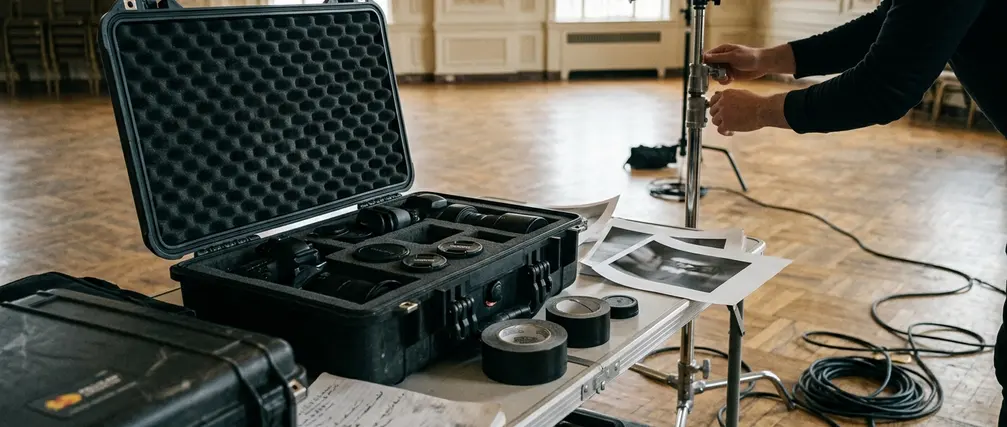
Main Point: Successful documentation of this venue relies on dividing the space into manageable zones to preserve both the romantic atmosphere and the architectural integrity.
The Challenge: Navigating Scale and Mixed Lighting
When evaluating the ambient light, the team initially considered relying solely on high-ISO ambient capture to preserve the mood, but rejected this approach because the severe color temperature clash compromised the final aesthetic. The physical dimensions of the venue feature high, ornate ceilings that render traditional bounce-flash techniques ineffective. Light simply dissipates into the cavernous space before returning to the subject, resulting in flat, uninspired exposures that fail to honor the elegance of the setting.
The ambient lighting conditions present a complex puzzle for digital sensors. Venue observations showed a stark contrast between tungsten chandeliers, circa 2700K, and LED uplighting in the vicinity of 4000K. This discrepancy creates a volatile environment where the warm, romantic glow of the historical fixtures fights against the cooler, modern entertainment lighting. Without deliberate intervention, this clash degrades the quality of the portraits, stripping the images of their natural romance.
The logistical challenges of capturing the signature mezzanine introductions while maintaining coverage of the guest reactions on the main floor add another layer of complexity. There is an on the order of 15-second window for the mezzanine introduction walk. Documenting the couple's descent while simultaneously capturing the awe of the guests below requires flawless timing and precise spatial awareness from the entire creative team.
Caution: Relying exclusively on ambient light in this environment risks muddy skin tones caused by ungelled strobes mixing with tungsten chandeliers, thereabouts 2700K.
Technical Implementation: A Strategic Lighting Network
To illuminate the grand space without destroying the romantic atmosphere, a specific off-camera flash setup is required. The lead photographer anchored the off-camera flash network to the balcony corners, cross-lighting the dance floor from above. Under reported conditions, this configuration uses four 200-watt-second strobes equipped with 1/4 CTO gels. These strobes are positioned at 12-foot elevations on the mezzanine railing, creating a canopy of controlled illumination.
Managing Color Temperature and Falloff
Applying color-correction gels on strobes blends artificial light with the warm tungsten glow of the venue's chandeliers. By warming the daylight-balanced flash output, the artificial light mimics the natural ambiance of the room. Adjusting strobe power output based on the specific color and intensity of the entertainment's LED uplighting ensures a harmonious exposure across the entire dance floor. This careful balancing act allows the subjects to pop against the background without appearing artificially superimposed.
To maintain the inverse square law of light falloff without blinding seated guests, the elevated positioning is critical. Evaluations reveal that placing the light sources high above the sightlines equalizes the distance between the flash and the moving subjects. This prevents the foreground from becoming overexposed while ensuring the background remains adequately illuminated during high-movement moments, such as the first dance or energetic group celebrations.
Expert Tip: Elevating the light sources mimics natural architectural illumination, preserving the depth and dimension of the room while protecting the guests' experience.
Compositional Approach: Balancing Grandeur and Intimacy
Coordination required mapping the transit routes—the lead photographer anchored the floor with a telephoto lens while the second shooter navigated the rear stairwell to secure the wide architectural context. Use of ultra-wide-angle lenses from the mezzanine level captures the sweeping architectural context of the ballroom. These wider focal lengths emphasize the dramatic arches and the sheer volume of the space, placing the couple within a grand, historical narrative that reflects the magnitude of their commitment.
Dual-Vantage Execution
Conversely, telephoto compression techniques isolate the couple during the first dance, minimizing background distractions while retaining environmental context. A longer lens compresses the distance between the couple and the ornate background, making the chandeliers appear larger and more prominent in the frame. Careful positioning of the photography team ensures simultaneous wide and tight coverage during critical timeline events, weaving together a complete visual story.
Ballroom at the Ben: Zonal Coverage Strategy| Coverage Zone | Primary Focal Length | Lighting Strategy |
|---|---|---|
| Mezzanine Introductions | 14mm - 24mm | Ambient capture with high ISO to preserve chandelier glow |
| Main Dance Floor | 85mm | Four-point cross-lighting |
Project Outcomes and Scope Limitations
During post-production, the editing team manually blended the ambient and flash exposures, prioritizing the retention of shadow detail in the ornate plaster arches over pure contrast. Evaluation of the final image deliverables highlights the successful preservation of dynamic range and architectural detail in print formats. The resulting photographs exhibit a rich, painterly quality that honors the venue's historic elegance while maintaining the authentic emotion of the subjects.
One catch—this specific four-point strobe configuration is strictly optimized for evening receptions; daytime events with heavy directional window light spilling into the ballroom require an entirely different balancing strategy. While this method provides strong coverage for evening galas, lighting consistency is never absolutely guaranteed across all seasonal daylight variations. The interplay of natural and artificial light demands constant recalibration to maintain the desired aesthetic.
Executing this level of environmental coverage typically requires at least a two-photographer team to manage the physical distance between vantage points. As a dedicated service provider, Faith West ensures these complex logistics are handled seamlessly, allowing the couple to remain fully present in their celebration. Comparisons demonstrate that dual-vantage coverage yields a fuller narrative of the celebration, capturing both the fleeting, authentic moments and the monumental scale of the day.