Executive Summary: The Case for Specialized Expertise
Luxury hotel venues present subtle technical challenges that require advanced photographic intervention. During the initial venue walkthrough, Faith West Photography evaluates the interplay between natural window light and artificial fixtures to establish a baseline exposure strategy. This assessment determines whether to embrace the ambient shadows or introduce supplemental illumination.
Mixed lighting environments and reflective architectural surfaces demand rigorous technical proficiency. Professional photographers provide essential logistical choreography within high-traffic, multi-use spaces. The resulting visual narrative relies entirely on this foundational preparation.
The Deceptive Nature of Controlled Environments
A common misconception persists that indoor, climate-controlled hotel venues offer an inherently simpler photographic environment than outdoor settings. In practice, the reality is different. Amateur practitioners frequently falter in these spaces due to an over-reliance on natural light—which remains severely limited in hotel interiors.
When framing portraits in historic Philadelphia venues like the Ballroom at the Ben, the photographer must carefully select focal lengths. Initially considering ultra-wide lenses to capture the entirety of a space often yields distorted perspectives, prompting a shift toward tighter, more deliberate compositions. Ceiling heights in historic converted ballrooms often range from circa 9 to 11 feet, severely limiting the ability to bounce flash effectively compared to modern 20-foot builds.
Main Point: Architectural constraints dictate the photographic approach. Mastery of a space requires adapting to its specific physical limitations rather than forcing a predetermined aesthetic.
Technical Implementation: Mastering Mixed Lighting
To maintain the atmospheric romance of a grand ballroom, the photographer measures the color temperature of the primary chandeliers and applies corresponding Color Temperature Orange (CTO) gels to off-camera strobes. Tungsten chandeliers typically emit light at 3200K, while daylight leaking from lobby windows sits around 5500K. Understanding the physics of mixed color temperatures is critical for seamless integration.
Off-camera flashes are often dialed down to around 1/16th or 1/32nd power to provide subtle fill light without destroying the ambient shadows. A classic failure case involves destroying the ambient mood lighting of a luxury reception by using un-gelled, direct flash that renders the background dark and the subjects unnaturally bright. Proper implementation requires adjusting flash power and gel density dynamically based on the specific dimming curve of the venue's chandeliers as the event transitions from dinner to dancing.
Logistical Choreography and Spatial Management
A dedicated in-house coordinator manages the venue's operational flow, but this does not eliminate the need for the service provider's logistical input. The photographer maps out the flow of hotel guests and coordinates with the banquet captain to identify brief windows of isolation in high-traffic areas. Executing a high-end portrait in a busy hotel lobby usually requires on the order of a 12 to 14-minute window of execution before guest traffic resumes.
This spatial awareness ensures private, elegant portraits amidst hotel guests and staff. The professional also scouts and secures secondary locations within the property for varied compositional opportunities. Repeated walkthroughs of Philadelphia venues suggest that identifying these secondary spaces prevents timeline delays.
Expert Tip: Always establish a secondary portrait location near the primary reception space to accommodate sudden shifts in the venue's public traffic patterns.
Scope and Limitations of Photographic Control
When setting up off-camera lighting near dance floors, the photographer evaluates the venue's safety regulations. Fire code regulations often require light stands to remain in the vicinity of 36 to 48 inches clear of all designated egress routes and doorways. Professionals can manipulate light and composition, but they cannot override strict venue policies—such as those regarding equipment placement or restricted zones.
One catch: historic preservation guidelines at certain legacy properties completely prohibit the use of clamp mounts or adhesive tape on architectural features, forcing a strict reliance on freestanding, heavily sandbagged light stands. This establishes realistic expectations regarding the timeline constraints imposed by hotel catering and event management.
Caution: Never assume standard rigging techniques apply to historic properties. Always verify preservation guidelines during the initial site visit.
Conclusion: Securing the Visual Legacy
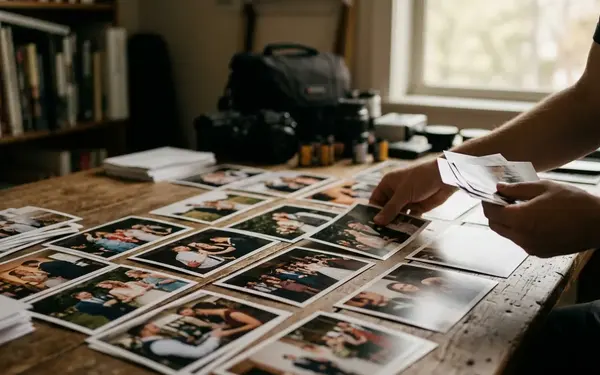
In the final post-production phase, lead photographer Faith West calibrates the color grading to reflect the specific atmospheric memory of the venue, deciding to retain the warm, golden hues of the reception space. The intersection of technical mastery and logistical authority is non-negotiable for luxury hotel weddings. Investing in a professional is an investment in risk mitigation and archival quality.
While advanced lighting techniques mitigate most indoor exposure challenges, absolute color fidelity remains subject to the specific spectral output of a venue's proprietary LED fixtures. Preserving the elegance and artistic integrity of the event requires a rigorous, methodical approach to both the physical space and the digital negative.