Establishing Baseline Camera Awareness in Old City
A couple navigates the uneven brickwork of Elfreth's Alley during a golden-hour window lasting roughly 45 to 60 minutes before sunset. The photographer initiates the session by directing them through a kinetic walking prompt. This deliberate choice allows the observation of their natural physical cadence and baseline camera awareness. The lens tracks their movements as they adjust to the presence of the camera. Categorizing pre-wedding photography outcomes into mechanical familiarity versus environmental comfort reveals a clear pattern. Mechanical familiarity transfers reliably to the wedding day. Couples understand cues and physical boundaries. Environmental comfort rarely makes the leap. The pacing and attire of an engagement session differ vastly from the main event.
The cobblestones of Old City Philadelphia provide a testing ground. The couple learns how it feels to be observed. The photographer learns how the couple naturally interacts. This initial interaction sets the stage for all future portraits. The golden light filtering through historic alleyways creates a romantic backdrop, yet the primary objective remains highly analytical. Faith West Photography utilizes this time to map the couple's comfort zones. The engagement session functions as a controlled experiment in human interaction.
Wardrobe Constraints and Timeline Pressures
The physical realities of wedding attire dictate a complete recalibration of posing directives. According to common estimates, a structured formal gown can weigh 15 to 20 pounds, restricting stride length and altering the subject's center of gravity. Early attempts to replicate the wide-stance, sweeping walking shots from the engagement session were permanently discarded after observing these limitations. The mobility of casual engagement clothing allows for a loosely structured exploration lasting in the vicinity of two hours. The wedding day operates on a highly scheduled timeline of circa eight hours. This pressure alters a couple's psychological state. The relaxed spontaneity experienced during engagement shoots gives way to the necessity of precision.
A groom in a custom tuxedo moves differently than he does in weekend attire. A bride navigating a crowded reception space requires different spatial awareness than she did in an open park. The photographer must anticipate these shifts. The transition from engagement to wedding day requires an adjustment in expectations. The density of the wedding day timeline introduces a cognitive load absent during the engagement shoot. Photographers must adapt their approach to accommodate these physical and psychological changes.
Developing a Verbal Posing Shorthand
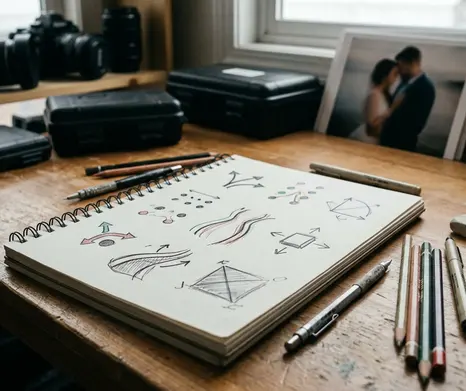
Couples retain specific, practical skills from their engagement session. The primary asset is a verbal posing shorthand—assigning specific terms to micro-adjustments like chin angle or weight distribution. On the wedding day, these corrections can be called out verbally. The photographer bypasses the need to step out from behind the lens to physically demonstrate. This efficiency proves vital for condensing a standard 15-minute portrait setup into an execution of 3 to 4 minutes or thereabouts during the cocktail hour rush. Establishing physical boundaries and preferred angles early allows the photographer to eliminate trial-and-error.
Communication Efficiency Takeaway: The development of a verbal posing shorthand during the engagement session directly correlates to the volume of portraits captured during the wedding day cocktail hour.
Faith West relies on this established communication to maintain momentum. This mechanical shorthand breaks down when the wedding day timeline falls more than 30 minutes behind schedule, forcing a shift from nuanced, cued posing to rapid, documentary-style capture. The shorthand requires a baseline level of calm to function effectively. When the timeline compresses, the photographer must rely on instinct and rapid execution. The engagement session provides the foundation for this efficiency, provided the timeline remains intact.
Identifying High-Yield Candidates for Pre-Wedding Portraits
The first ten minutes or thereabouts dictate the entire approach. The photographer evaluates the couple's interaction dynamics immediately. Highly structured, directive prompts serve camera-shy individuals who require a low-stakes environment to build trust. Loose, observational framing suits those who naturally self-direct. Couples with complex family dynamics or high-anxiety tendencies benefit immensely from establishing this rapport baseline. Drawing on a review of Ballroom at the Ben event records spanning the previous wedding season, establishing this baseline reduces visible tension in formal portraits. The engagement session acts as a diagnostic tool.
Does the couple need constant reassurance, or do they thrive with minimal intervention? Answering this question early streamlines the wedding day workflow. The insights gained during these initial moments inform every subsequent interaction. The photographer maps the emotional landscape of the couple. This mapping process ensures that the wedding day photography feels authentic and tailored to their specific dynamic. Identifying these traits early prevents miscommunication during high-stress moments.
Framing the Rehearsal for Maximum Impact
During the initial client consultation, the photographer deliberately frames the engagement session as a low-stakes mechanical rehearsal. Stripping away performance anxiety allows the couple to focus entirely on establishing communication rhythms. Limiting the expectation of engagement session transferability to verbal posing cues rather than timeline pacing or attire mobility sets realistic boundaries. The true value lies in eliminating the introductory phase. Wedding day photography begins with immediate, established trust. The couple arrives on their wedding day already fluent in the photographer's visual language.
Couples must treat the engagement session strictly as a mechanical rehearsal and communication exercise. Approach the shoot as a practical workshop to learn the photographer's cues and establish physical boundaries. Focus entirely on building a functional, efficient communication loop with the photographer. This preparation carries that shared shorthand into the first wedding-day portraits.