The sky changed before the rain arrived
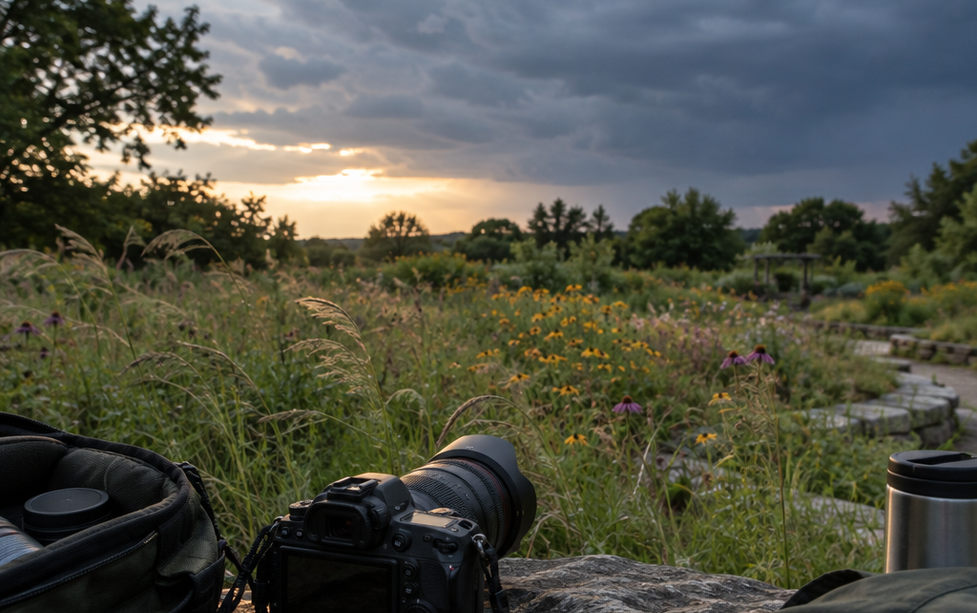
The temperature fell on the order of 15 degrees over the lower meadow at Bartram’s Garden. Above the couple, the sky turned a bruised purple. No rain had reached us yet, but the session had already changed: relaxed pacing gave way to a short, deliberate sequence of photographs and a clear route to shelter.
A fast-moving summer storm calls for three decisions in quick succession: where to photograph while the light lasts, which lens will keep the couple sharp as that light falls, and where everyone will go when the meadow becomes exposed. At Bartram’s Garden, the answer to the last question was the stone barn. Knowing that before the first heavy drops mattered as much as the camera settings.
The resulting gallery drew its character from the storm’s approach. Dark sky gave the portraits scale; the couple’s closeness held attention against it. That tension was worth photographing while conditions remained safe, without treating the weather as something we could control.
Working quickly in Bartram’s lower meadow
The open meadow offered the broad view needed to place the couple beneath the approaching front. It also left little room for delay. As the radar shifted, I brought forward the photographs that depended on an unobstructed sky: wider compositions first, then closer frames that could survive a move toward the barn.
That order kept the shot list useful. A portrait against an open horizon cannot simply be recreated beneath a stone overhang. A close photograph of two people together can. I gave the couple simple directions, with enough time between them to settle into each frame. The visible storm supplied urgency; the directions did not need to add to it.
A lens that kept conversation close
I switched to a 35mm f/1.4 lens to gather more ambient light while retaining the darkening sky in the composition. Shutter speed stayed above 1/250s to help hold the couple sharp as the wind and light changed. Focus still needed attention: a wide aperture increases light gathering, yet leaves less depth in which both faces can remain crisp.
A longer telephoto lens had been the plan for compressed portraits. Its working distance would have made quick communication harder. The 35mm let me stay near enough to give a brief cue, check the couple’s response and move with them when it was time to leave the meadow.
Finding light at the stone barn
The first heavy drops marked the end of the meadow sequence. We moved directly to the stone barn, within a five-minute walk of the shooting spot, and worked beneath its west-facing overhang. The choice was about light as well as cover: remaining directional light could reach the opening and bounce from the wet ground toward the couple.
Historic Philadelphia venues reward this sort of mental mapping. Experience with their older structures makes it easier to recall an overhang, identify its orientation and judge whether a nearby opening will still provide usable natural light during a downpour. The relevant knowledge here was specific: the barn’s west-facing side gave this session an accessible place to continue photographing.
The enclosure demanded another exposure decision. Stone reduced the available ambient light, so I pushed ISO to circa 1600. I also worked at a distance suited to the barn’s tighter space rather than trying to preserve the meadow’s broad framing. The overhang and light pocket shaped the portraits; there was no need to make the barn look like an open field.
Rain cover and storm shelter are separate decisions. An overhang can protect a camera and clothing from rain, but it is not a safe place to remain during a lightning threat. If thunder is audible, photography stops and everyone moves to appropriate shelter. The National Weather Service thunderstorm safety guidelines provide the standard for that call.
A storm plan couples can actually use
A useful contingency plan names a route and a location before anyone dresses for the session. At Bartram’s Garden, the meadow-to-barn walk stayed within a five-minute radius. In the hours beforehand, I watched high-resolution radar loops in 10-minute increments, following the movement of storm cells rather than treating a general chance-of-rain percentage as a schedule. That approach kept the couple no more than 400 yards from a structural fallback while we photographed outdoors.
For another session, I would check the same practical points in this order:
- Identify the fallback. Choose a definite, accessible location within a five-minute walk of the primary spot. Check the route as carefully as the destination.
- Read the radar as movement. Compare successive loops to see where a cell is travelling, then shorten the outdoor shot list when its path approaches the location. Radar informs timing; it does not replace a lightning-safety decision.
- Pack layers that belong in the photographs. A coat, wrap or jacket that suits the couple’s clothes can answer a sudden temperature drop without requiring a change of look. Secure loose layers before high winds make them distracting or difficult to manage.
- Check the light at the backup spot. An open-sided overhang facing an ambient light source may support natural-light portraits. A fully enclosed space may require flash instead.
The plan should be easy to say aloud: where we are going, how we will reach it and when outdoor photography ends. That clarity gives the couple something steadier to follow than the changing sky.
Choosing the atmosphere you want to remember
Pre-storm light can give an engagement gallery a cinematic weight that a clear afternoon rarely offers. At Bartram’s Garden, the dark horizon and quick shift toward the barn became part of the visual sequence. The photographs could hold both the openness of the meadow and the intimacy of shelter.
That aesthetic asks something of the couple. Wind may move carefully arranged hair; wet ground may mark a hemline; the pace may change with little warning. In a pre-session consultation, I compare clear-day and pre-storm galleries so couples can judge those trade-offs against the photographs they hope to keep. Some prefer time to linger in one place, with light and clothing behaving predictably. Others welcome the brief, charged atmosphere before a storm, provided the safety plan is firm.
Are you willing to trade the predictability of a clear forecast for the dramatic, unrepeatable atmosphere of a passing storm?