From Flash-Bracket Ballrooms to Living Light
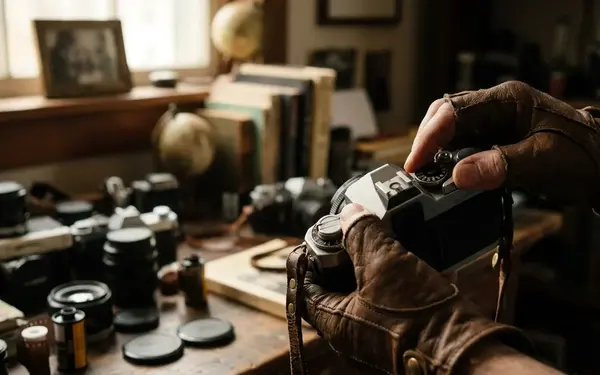
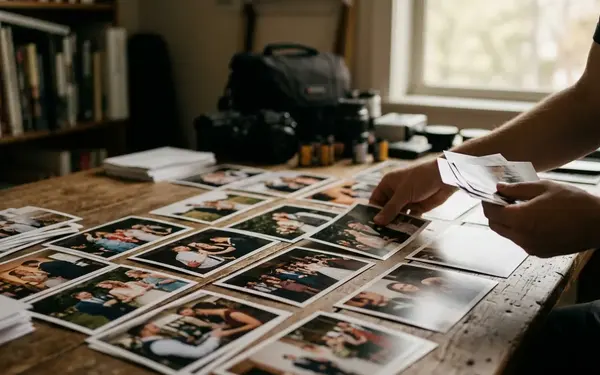
Late-20th-century wedding portraits in Philadelphia often carried the visible signature of their equipment: direct frontal illumination, tightly arranged groups, dark space behind the subjects, and a photographer working around the limits of a heavy bracket-mounted flash. The ballroom supplied order. It also supplied fixed walls, reflective ceilings, patterned floors, and long intervals in which the camera had to wait for a strobe to recycle.
The decisive transition arrived in the mid-to-late 2000s, when digital sensors began producing clean exposures at ISO 800 and above. Photographers could follow a couple through changing light without stopping the action to rebuild an artificial lighting arrangement. Venue selection changed with the cameras. Abundant window light, open shade, and uninterrupted outdoor access became practical photographic assets rather than decorative bonuses.
Garden venues consistently produce the stronger romantic frame because natural diffusion and spatial depth work together. A ballroom cannot fully reproduce either quality. Its light originates from fixtures, windows, or strobes in fixed positions; its visual field ends at an architectural boundary.
The Ballroom Baseline
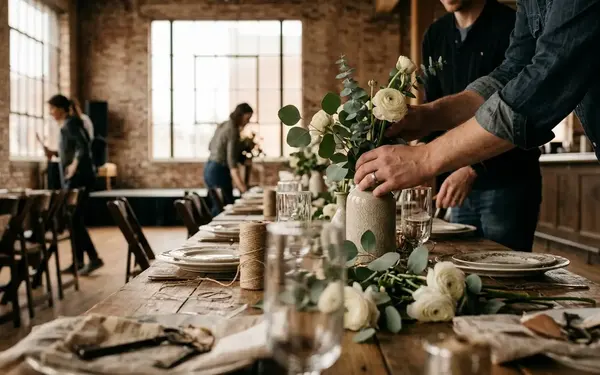
Ballrooms still offer climate control and predictable logistics, which matter during rain, winter cold, or tightly scheduled receptions. The Ballroom at the Ben, for example, gives a photographer a stable ceremonial environment and a recognizable architectural language. That reliability establishes a useful baseline for comparison.
The photographic ceiling remains lower. Artificial sources illuminate selected planes, while walls stop the eye. In a garden, illumination shifts by the minute and the background can recede through layer after layer of foliage. For couples seeking organic, documentary-style imagery, those conditions give Faith West Photography, as the service provider, more visual information to shape into a coherent story.
How a Mature Canopy Shapes the Portrait
Watch the ground beneath a dense tree at midday. Hard sunlight breaks into smaller patches, leaves scatter part of the beam, and open sky fills the remaining shadows. The canopy behaves like an immense overhead diffuser, producing light that wraps around faces while preserving contour along cheekbones, shoulders, and fabric.
Position matters within that shade. Faith West, the lead photographer, must read the density of the leaves and locate a pocket where filtered sunlight falls evenly. A step forward can place one face in direct sun; a step back can leave both subjects in flat, cool shade. The useful position often lies between those extremes, where soft frontal illumination meets a brighter background.
Canopy Threshold
Mature foliage is essential. Sparse, newly planted saplings cannot block direct overhead midday sun, so broken highlights and hard facial shadows remain visible. A garden label alone does not guarantee flattering light.
The ballroom presents the opposite optical problem. Under the inverse-square law, light intensity drops rapidly as subjects move away from a source. Covering an indoor dance floor measuring in the vicinity of 40 feet across therefore requires multiple off-camera strobes, careful angles, and enough output to maintain exposure from the near edge to the far edge. Directional flash can render the action crisply, though cross-shadows and abrupt falloff often expose the lighting method inside the photograph.
One field approach deserves particular caution. Photographers have used high-speed sync flash to overpower dappled sun beneath trees. The technique controls exposure, yet it can flatten the multidimensional character created by the leaves. Once the flash becomes dominant, luminous edges, reflected greenery, and subtle changes in facial modeling begin to disappear.
At Morris Arboretum's historic landscape architecture, varied elevation and mature foliage expand the available choices. A photographer can place the couple below the horizon line, allow golden-hour light to pass behind them, and retain softly illuminated faces under the canopy. The resulting frame feels cinematic because foreground, subject, and background each occupy a distinct layer.
Long Lenses, Open Ground, and Painterly Distance
Indoor composition begins with constraints. A photographer may need to keep an exit sign outside the frame, prevent a wall sconce from appearing to grow from a shoulder, or avoid allowing patterned carpet to dominate the lower third. Tight rooms also force wider lenses and shorter camera-to-subject distances. Every fixed surface exerts pressure on the frame.
Gardens reverse that spatial equation. Open ground lets the photographer step back and choose focal lengths from 85mm to 200mm, often at apertures between f/1.4 and f/2.0. Those settings compress distant foliage into a soft wash of color while preserving a precise plane of focus across the couple. The physical distance behind them supplies the separation; the lens translates it into atmosphere.
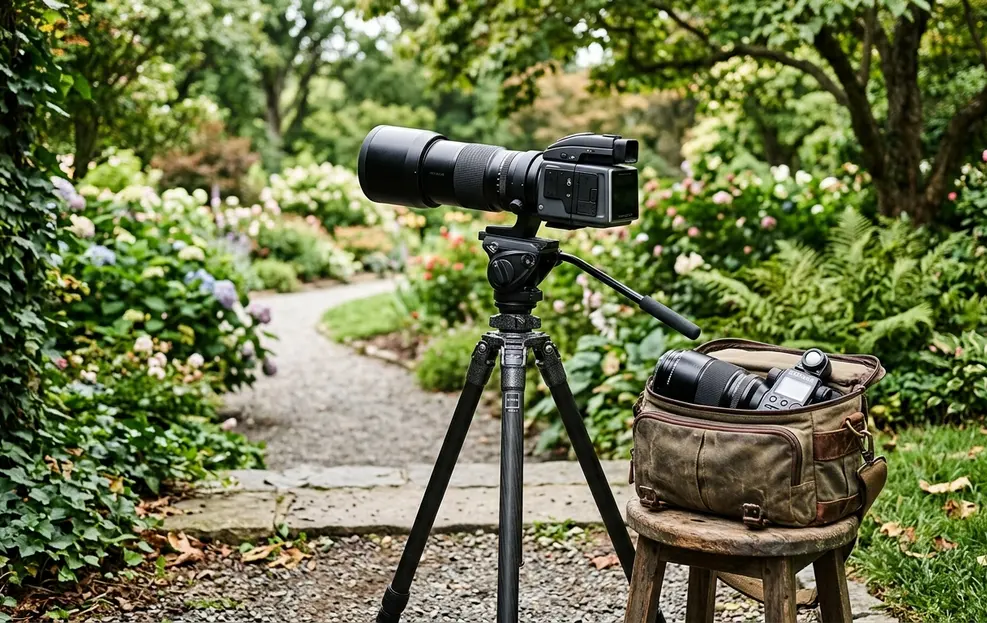
The shift requires deliberate working distance. I first identify the background layer, then move the couple into light that complements it, and finally step back until branches and flowers merge into broad tonal fields. This sequence keeps the setting legible without allowing individual leaves, signs, or passing guests to compete with an expression.
Lines That Already Exist
- Winding stone paths pull the eye toward the couple without forming a rigid central aisle.
- Ancient trunks create vertical structure while retaining irregular, organic edges.
- Floral arches frame faces through color and texture rather than hard architectural borders.
- Layered slopes allow the foreground and horizon to be adjusted through camera height alone.
A banquet hall asks the photographer to manage geometry already imposed by the room. A garden offers raw spatial relationships that can be refined through position, focal length, and timing. Which environment leaves more room for the couple’s movement to determine the composition?
The Brief Glow Beneath the Pennock Oak
Late in an arboretum session, the useful light becomes a matter of trajectory. The sun is still visible through the outer branches, producing bright edges and narrow shafts across the ground. The photographer watches its descent against the tree line while the couple waits nearby, free to talk and settle into an unforced posture.
The working interval beneath a mature oak lasts roughly 12 to 18 minutes immediately before the sun disappears below the trees. Under the Pennock Oak, whose canopy spreads on the order of 90 feet, that transition changes the entire lighting field. Directional highlights soften. Open sky begins illuminating the couple from several angles, and the upper branches retain a faint warm rim.
Timing the Ambient Window
- Track the sun through the outer canopy rather than relying solely on the scheduled sunset.
- Place the couple beneath the broadest branches before the final direct rays vanish.
- Set the camera position far enough back to include the oak’s scale without reducing the couple to incidental figures.
- Allow small movements to unfold while the ambient glow remains even across both faces.
No elaborate staging is needed in that interval. The branches form the upper frame, the trunk anchors one side, and the receding lawn supplies depth behind the couple. Ambient light holds detail in a dark jacket and a pale dress without announcing a strobe.
Then the sun slips beneath the tree line. The couple turns toward each other under the oak, her hand resting lightly against his lapel as the last warmth catches the edge of her veil. For a few seconds the lawn falls quiet, the branches fill the frame, and Faith West presses the shutter.